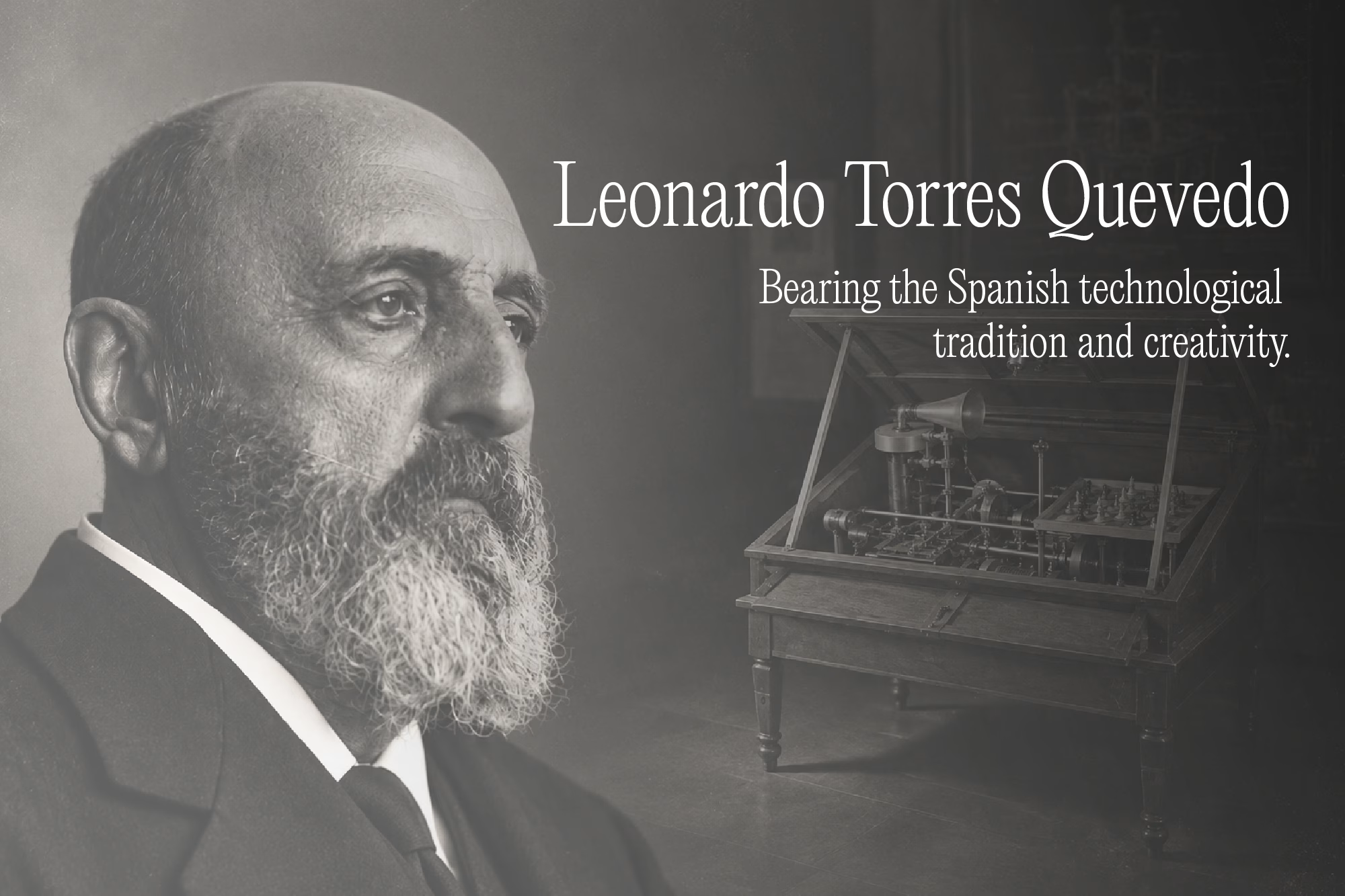
In 1903, Cantabrian engineer Leonardo Torres Quevedo presented a device to the French Academy of Sciences that was capable of receiving and carrying out commands transmitted by radio waves. He called it the Telekino, and it is considered the first radio-controlled device in history.
His aim was to demonstrate that a machine could receive instructions remotely and act on them, without the need for a person to be physically present next to the equipment.
Years later, in 1912, he presented El Ajedrecista, an automaton designed to solve a king and rook versus king endgame in chess. The system combined electromagnets, electrical sensors and a mechanical arm to analyse the position, make the moves and complete the game autonomously.
The invention was one of the earliest examples of a machine capable of operating according to a predefined set of rules and making decisions within that framework. For this reason, it is now regarded as one of the precursors of artificial intelligence.
Torres Quevedo used the term Automatics to refer to this field of work and developed many of his ideas decades before automation acquired the industrial meaning we know today.
More than a century later, some of those principles are still present in our day-to-day work.
One is the ability to operate a machine without being physically in front of it. Today, this can be seen, for example, in remote assistance systems that make it possible to check parameters, diagnose issues and provide support for equipment installed on the factory floor.
Another is the ability of a machine to interpret information from its surroundings and automatically adapt how it operates. This is what happens when a machine detects the dimensions of a box and makes the necessary adjustments without having to stop the line to change its configuration manually.
Technology has advanced enormously since those early experiments, but engineering still has a great deal to do with finding solutions to problems for which no standard answer yet exists.
