Sustainability is becoming increasingly important in the industrial sector. Companies in the production sector are driven by the market, regulations and customer demands to reduce the environmental impact of their internal processes.
This leads organizations to continuously search for measures that will enable them to reduce energy consumption, use their resources more efficiently and adopt new technologies that facilitate smarter and more sustainable management.
The main intralogistics trends show the adoption of solutions that help optimize storage spaces, save energy, automate processes and, especially, use materials to their full potential and reuse valuable waste, such as cardboard boxes.
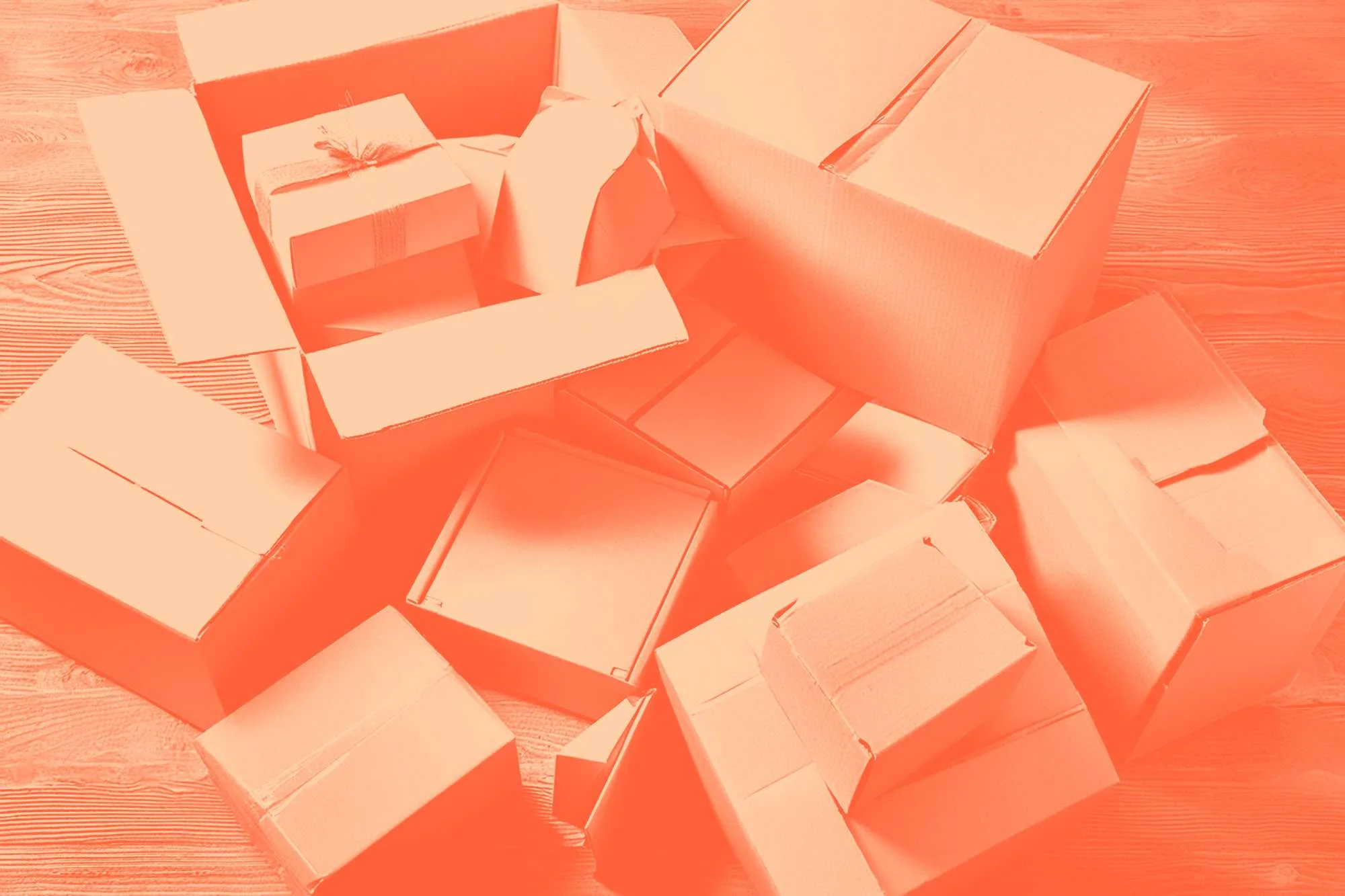
In this post we focus on the reuse of cardboard boxes as a strategic measure to boost logistics sustainability. We talk about its advantages for the company and how to implement it through automated solutions.
What is the reuse of cardboard boxes?
In the field of intralogistics, this sustainable practice involves taking advantage of cardboard boxes from suppliers that supply the company, to use them as outgoing product boxes or as an internal storage solution.
It consists of applying a systematic process to ensure the viability and efficiency of the boxes for their second cycle of use. It mainly involves the operations of collection, inspection and preparation of each unit for reuse.
Collection and inspection of used boxes
In the product or raw material reception area, cardboard boxes are collected from suppliers, disassembled and flattened, and then subjected to a rigorous evaluation to determine their structural condition.
- What aspects are inspected? For example: the presence of contaminants, the integrity of corners and flaps, the stability and strength of the walls, the resistance to stacking (compression) and the presence of labels. These tests are essential to ensure the quality and safety of future packaging.
Adaptation and reconditioning of boxes
The boxes that have been selected must undergo a reconditioning process, in which old labels are removed or any other residue is eliminated. They can even be reinforced to ensure their integrity.
Depending on the quality and strength of the cardboard and the dimensions required for the packaging, boxes can be resized to suit the specifications of the new products they will contain. For this purpose, cutting and creasing machines can be used to reconfigure used boxes and adjust them to new dimensions.
Integration of used boxes into the logistics flow
The reusable packaging is assembled by an automatic case erector. Each assembled unit is picked up by the automatic case erectors to be positioned on the overhead transformers.
These automatic case packers are equipped with gripping mechanisms and sensors to ensure that each case is carefully handled by the machine and correctly deposited on the conveyor. To ensure the optimal flow of the logistics chain, it is necessary for this type of equipment to be able to operate with used crates.
Benefits of reusing cardboard boxes
Although at first glance it may seem a simple or straightforward measure, the use of used cardboard boxes is a practice that provides great benefits in the short and long term.
Of course, it requires a change in corporate culture to focus on waste reduction. In addition, it is important to ensure that the amount of packaging from current suppliers can meet, at least in a percentage, the company’s current demand for boxes.
Let’s take a look at the main advantages of reusing cardboard boxes:
- Reduction of operating costs. This is due to the fact that:
- Reduces the need to purchase new packaging units. Even the company’s dependence on suppliers is reduced.
- Minimizes waste disposal costs. By using existing boxes, waste generated and waste management costs are reduced.
- Immediate availability of sustainable packaging. When cartons are reused, companies maintain a continuous stock of packaging. This makes it easier to respond quickly to customer demands and possibly improve delivery times.
- Packaging versatility. By using automated solutions, such as slitters or case erectors suitable for used cases, the company can adapt the packaging to different sizes and types of products.
- Reduced carbon footprint. Globally reduces both the demand for raw materials and the energy consumed in the manufacture of new paperboard.
- Reduction of solid waste from the industrial sector. This reuse process extends the useful life of cardboard boxes and significantly reduces waste generation. It is a practice that promotes the circular economy.
- Improved corporate image. Companies that adopt sustainable practices, such as implementing eco-efficient machines to give cardboard boxes a second life cycle, send a message of commitment to sustainability. As a result, they are preferred by customers.
Automated solutions that allow reusing cardboard boxes
Integrating sustainability and automation within internal logistic processes is a key trend to increase operational efficiency and, at the same time, reduce energy consumption and achieve a second use for cardboard packaging.
The following is a description of TECNIMUSA’s main intralogistics automation solutions that can operate with both new and used crates.
Automatic case erector
It is a machine that feeds the flat cardboard, folds the material along the pre-marked lines and converts it into ready-to-use boxes. This automatic case erector is a sustainable technological solution, suitable for both new and used cartons. It can be equipped with a sealing module, either by gluing or sealing.
In addition, it has an intelligent system that allows it to automatically and precisely adjust to different box sizes. It can even be programmed to form special case formats.
Automatic box transferer
It is an automated solution that positions and aligns the boxes on the overhead conveyor. It detects empty trays in the circuit and incorporates the boxes, all autonomously. Its advanced system allows it to operate precisely and avoid stumbling.
The main features that distinguish this box transferer are its ability to handle both new and used cartons. In addition, it adapts to various packaging formats and different conveyor speeds.
Sealing machine
After the cartons are filled, conveyors move them to the end of the production line. At this point, an automated system can be integrated for automatic closing and sealing of the cartons, suitable for new or used cartons.
For example, the case sealer can operate with both new and used cases. This advanced machine detects the format of each box and automatically adjusts to the dimensions of the packaging, proceeding to the longitudinal sealing at the top and bottom.
In general, especially in high production environments, for an excellent reuse of cartons it is essential to use automated solutions that optimize the workflow, adapting to new and used cartons and different packaging dimensions.
Tecnimusa. Sustainable and eco-efficient automation solutions
As an engineering company, we maintain our focus on the continuous ecological improvement of intralogistics processes in the industrial sector. We design and manufacture energy-efficient automated solutions that ensure optimal material flow, maximum resource utilization and reuse of cardboard packaging.
