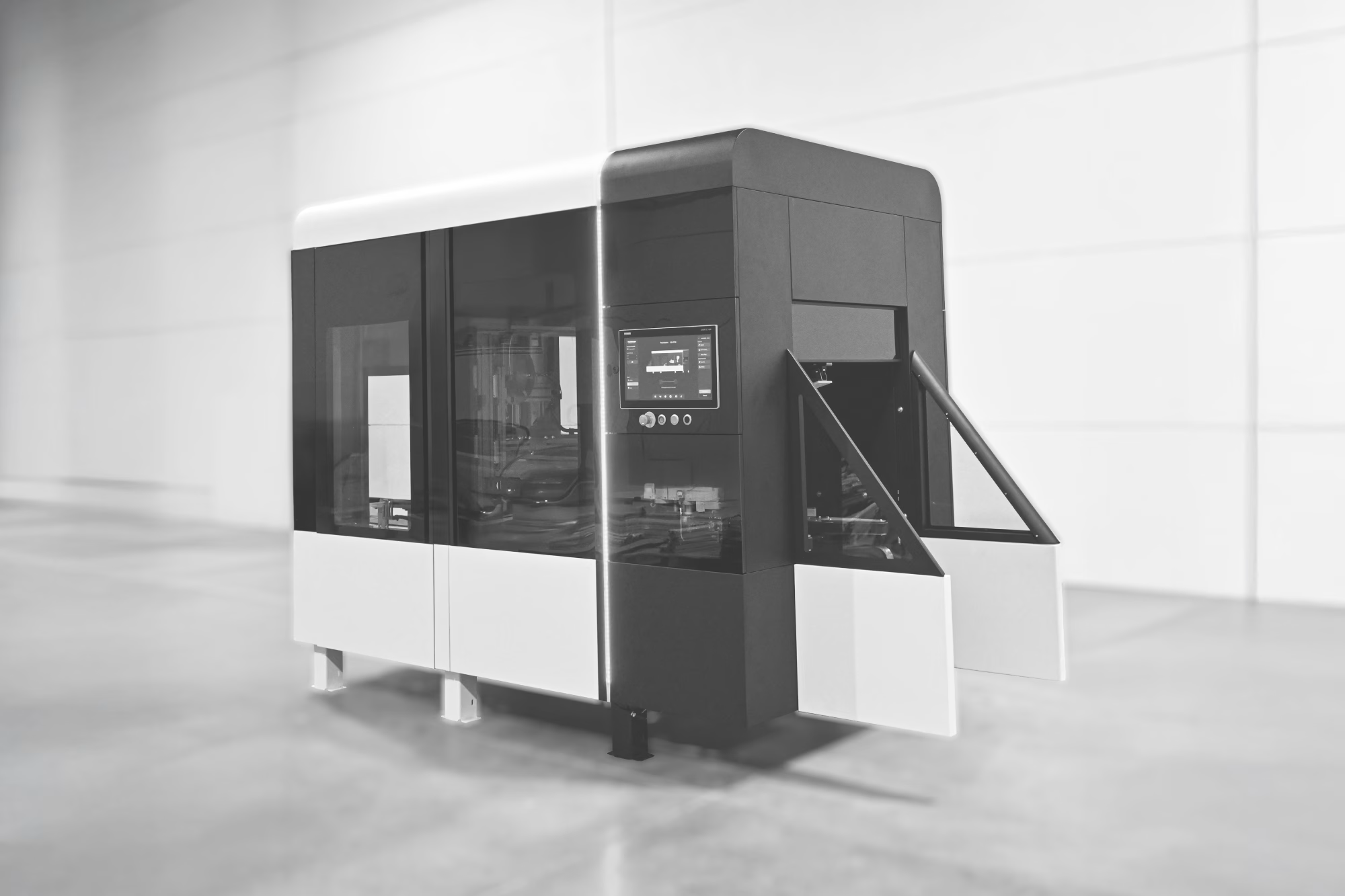
Staying ahead of the curve in today’s competitive and changing landscape requires the transformation of industrial and intralogistics processes, as well as the adoption of technological solutions that optimize operations to boost productivity, reduce costs, and improve the customer experience.
One of the most transformative solutions is automation. But these must be automation solutions that adapt to the operational demands of the industry, plants, or logistics centers, integrating seamlessly into the production and distribution infrastructure of the facilities. It must be customized automation. This is the way to truly improve the company’s performance, maintain flexibility to respond to the market, and even reduce waste and minimize energy consumption. Because the goal is for the solution to fit the needs of the company, not to force a process to adapt to what is already available and ready to use.
In this post, we detail, phase by phase, the professional process of developing and manufacturing customized automation equipment, from requirements analysis to equipment integration and ongoing technical support. We show how each stage is a key link in ensuring the long-term efficiency, reliability, scalability, and sustainability of intralogistics operations.
Process of ideation, design, and manufacturing of customized industrial automation solutions
When we talk about custom automation, we are referring to the design and implementation of specific solutions (machines and systems), developed under a rigorous process, governed by engineering criteria to precisely meet the unique needs of a process.
This approach is not limited to installing technology, but rather involves coordinating each phase with a single purpose: to ensure that automation brings real and measurable value to operations.
In this process, two aspects are decisive:
- The choice of technology partner. An equipment supplier is not enough. A partner is needed who is capable of understanding the operation, translating it into technical specifications, and accompanying the company from conception to commissioning and support. The quality of the partner will also define the degree of reliability, scalability, and return on investment of the project.
- The scale of the solution. “Automation” is often associated with large and complex technological solutions, smart storage, high-speed shuttles, robotic installations, etc. However, these solutions can represent an excessive or unnecessary investment for small companies. Customized automation also involves intelligently optimizing individual processes or specific stages of production, such as picking stations, packaging lines, or sorting flows. It consists of designing solutions that are proportional and adapted to the size of the company, allowing for progressive and sustainable evolution towards higher levels of efficiency.
Let’s look at the stages of the development and manufacturing process for customized equipment for industrial intralogistics processes:
1 Requirements gathering
In this initial phase, the company’s automation needs are identified and detailed requirements are gathered to ensure that the solution created addresses each of the critical aspects of the process.
The technology partner conducts exhaustive consultations and maps the processes to evaluate workflows, detect areas for improvement, and identify bottlenecks and other challenges. The conditions of the environment, available space, resources, and limitations are documented.
- Which tasks should be automated? Mainly those that are time-consuming for workers, are performed frequently, and have a significant impact on productivity. Also, those tasks that involve excessive labor costs or are dangerous and high-risk for workers. This may include activities associated with order preparation and packaging, labeling and tracking of items, lifting or transporting loads, etc.
In this step, at TECNIMUSA we work closely with the customer to ensure that the solution addresses all the critical aspects of their business and to obtain a complete overview of the production or intralogistics process, as well as any special ergonomic technical constraints that will be included in the design of the solution.
2 Conceptualization and ideation
Conceptualization is the phase where the engineering team’s experience and capacity for innovation come together to transform the requirements gathered into viable concepts for automation. The goal is to generate, evaluate, and select the most appropriate solution for the company, considering its technical and sustainability needs and market demands.
In this conceptualization and ideation stage:
- Problems are identified and the objectives of the automation project are defined. Acceptance criteria, plant constraints, and KPIs are established.
- The expert, multidisciplinary engineering team brainstorms to come up with alternative solutions. These ideas are prioritized using decision matrices and advanced analysis that consider cost, performance, risk, and sustainability.
- The ideas are refined through R&D. This includes market research (customer trends and competition) and technical research (materials, technologies, processes, etc.), the identification of technical risks, and the evaluation of integration. This serves to rule out options.
- Depending on the project, initial sketches or prototypes are created, either virtually through simulation or physically, to establish the functionality and scope of the solution and to reduce technical uncertainty.
- Finally, the winning concept is selected, which may contain an optimized combination of several ideas. This validated concept forms the basis of the engineering design.
At TECNIMUSA, we have a long history of innovation and reliability. We dedicate a high percentage of our budget to our R&D department.
Our work philosophy is to offer intelligent, fast, reliable, and eco-efficient automation solutions. Therefore, in our ideation process**,** we also introduce **sustainability criteria** based on customer requirements and objectives, current regulations, and the future vision of a green industry. We do not only focus on reducing energy consumption, but we also introduce criteria for packaging recycling, improving worker ergonomics, component durability, etc.
3 Engineering design
This is the stage at which the initial design concept is defined. The engineering team integrates hardware, software, and specialized components. It creates detailed plans and defines the physical layout of the equipment, the circuit layout, and the control algorithms.
At this stage, at TECNIMUSA, we incorporate high-performance components that optimize energy consumption and require minimal maintenance, always ensuring the functionality of the solution with the customer’s technological ecosystem.
4 Manufacturing
This involves selecting the appropriate materials and coordinating with suppliers to purchase or manufacture components, all in accordance with the design specifications and established eco-efficiency criteria.
A flow chart is established for the production process and the most suitable manufacturing methods are selected for the automation equipment to be created: welding, machining, additive manufacturing, etc. Finally, the subsystems are assembled and calibrations are implemented. All of this is carried out under strict quality controls.
At TECNIMUSA, we have a production team that is responsible for manufacturing the machine designed for the advanced automation of intralogistics processes. Our suppliers are certified. We have specialized workshops for manufacturing, meticulous assembly of the various subsystems (mechanical, electrical, electronic), software installation, programming, and configuration of each parameter.
5 Validation
The next step is to verify that the automation machine works according to the design and complies with regulatory standards. To do this, functional tests are carried out, simulating the operation of the machine under real load conditions, verifying safety, synchronization, data collection, etc.
At TECNIMUSA, we assess compliance with industrial safety and quality standards. Only after successfully passing these tests do we proceed with implementation at the customer’s facility. All our automation projects are subject to rigorous quality control through our QMS system based on the ISO 9001 standard. This certifies that we develop and deliver our products and services guaranteeing compliance with customer requirements and respecting the current legislation of their operating environment.
6 Integration, commissioning, training, and support
Once the equipment has been validated, the technology partner coordinates logistics with the customer and supervises the entire assembly process. In addition, through its team of engineers, it leads the on-site commissioning to configure control parameters, integrate the new system with existing processes and technologies, calibrate sensors, and ensure that the solution will maintain maximum efficiency and smooth operation.
At TECNIMUSA, we provide comprehensive support to our customers. We complement the commissioning with a training process for operators, so that they can master the use and configuration of the equipment and so that the customer can acquire total control over their production line and operate with complete autonomy.
And to guarantee continuous support, our machines incorporate a remote assistance system that allows parameters to be viewed and verified. Thanks to this connectivity, we offer our customers 24/7 assistance and a rapid remote response. If any incident requires more than this initial remote diagnosis, our technical team will travel to the customer’s premises.
This is how we guarantee your peace of mind and the continuity of your line.
TECNIMUSA: customized automation solutions for industry
We devise, design, and manufacture intelligent and eco-efficient automation machines for industrial intralogistics. We are present in the most competitive international markets.
If you want to take the step towards sustainable automation, contact us. We will create a solution tailored to your needs.
