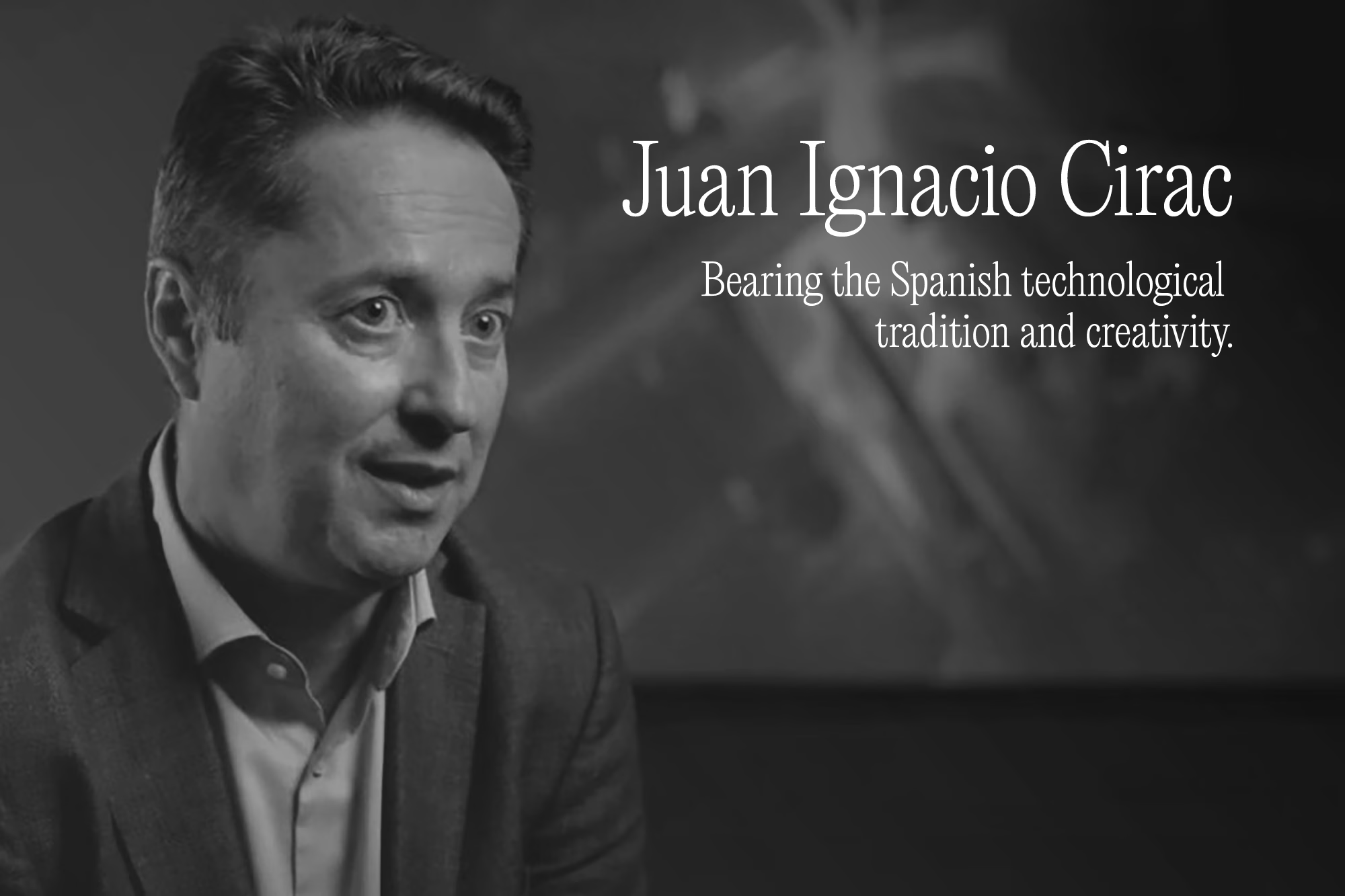
For decades, quantum computing was considered impossible. A Spanish physicist changed that. Juan Ignacio Cirac, who earned his Ph.D. from the Complutense University of Madrid laid the theoretical groundwork for what is now one of the most transformative technologies of the century.
A classical computer uses bits (which can be 0 or 1), while a quantum computer uses qubits, which, thanks to superposition, can exist in both states simultaneously and process multiple possibilities. The challenge? Making them work.
It all began in the 1990s, at an international conference on atomic physics in Colorado.
One speaker ended his talk with a statement: “We don’t know how to build a quantum computer; we don’t even know if it’s possible.”
Cirac was sitting next to Austrian physicist Peter Zoller. The pieces fell into place in their minds: they were working with trapped ions.
They looked at each other and said, “Well, then, we probably know how to build a quantum computer.” The thrill of innovation took hold of them.
That “impossible” feat has become a tangible model that merges quantum physics and computer science. It’s a new way of processing and transmitting information:
Cirac proposed using trapped ions to carry quantum information, which are controlled by lasers and magnetic fields. It’s the most precise approach to date.
Prototypes are already running simulations that are impossible even for the world’s most powerful supercomputer. Although scalability challenges still need to be overcome.
The greatest benefits remain unpredictable for now, but the groundwork has been laid. Today, this Spanish physicist heads the Theoretical Division of the Max Planck Institute for Quantum Optics.
Cirac changed the rules for the future. He didn’t wait for the technology to exist, nor for anyone to think it was possible.
At TECNIMUSA, we share that passion for the unprecedented.
